


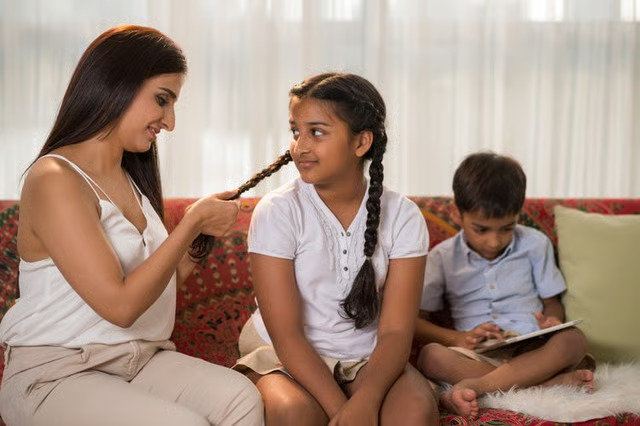
Indian immigrant families in the U.S. may have a number of child-rearing customs and beliefs that differ from those of other U.S. families, depending on the extent to which the family tries to maintain their Indian traditions. Some families are willing to adapt their traditions to American society, while others try to retain a distinctly Indian identity.
The Extended Family
In Indian society, extended family members typically live together in one large household rather than maintaining their own separate homes. Brothers may live with each other in adulthood, or grandparents may live with a young couple to help them raise their children. In India, grandparents are typically much more involved in childcare than most American grandparents, even though Indian mothers usually stay home to watch the children. According to the Molina Institute for Cultural Competency, Indian mothers in the U.S. sometimes work outside the home for economic reasons, while the grandparents provide childcare. Because the grandparents are usually just as involved in childcare as the parents, if not more so, Indian children are often just as close to their grandparents as their parents.
Parental Authority
The father is the head of the Indian household, especially when dealing with outsiders, and the mother traditionally follows his lead. In Indian culture, parents traditionally have much more authority over the lives of their children than American parents do. Children are expected to be obedient and respectful toward their parents and other elders and to take care of them as they get older. Children are also expected to do as well in school as they possibly can, as education is highly respected in Indian society.
Dating
Arranged marriage is the norm in Indian culture, but Indian teens in the U.S. are sometimes allowed to date under parental guidance and supervision. Both boys and girls are often sent back to India for an arranged marriage. Indian teens in the U.S. sometimes date without parental permission, either secretly or in defiance of their parents.
Changing Customs
Indian immigrant families in the U.S. often find it difficult to apply Indian beliefs about raising children in American society. American children are not expected to be as obedient or respectful as Indian children traditionally are. Gender roles in the U.S. give girls much more independence than is traditional in Indian society, so many Indian girls raised in America are more interested in dating and eventually marrying outside of their culture. Indian families are frequently forced to find a balance between their traditional parenting customs and their new home.