

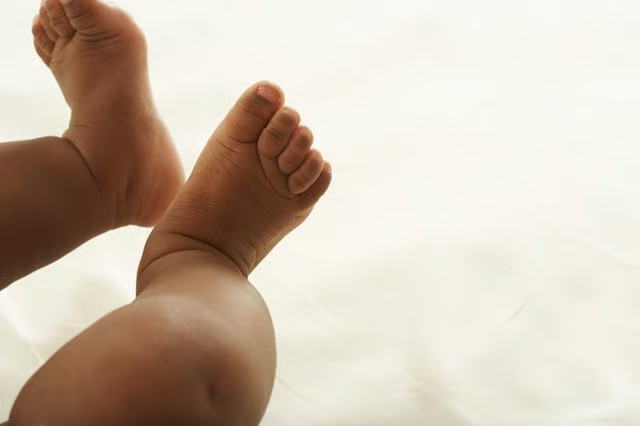
During their first year, babies progress developmentally from simple reflex movements to pulling up and walking.
Babies need opportunities to stretch, move and strengthen leg muscles in order to promote healthy leg development. Understanding leg development will help you choose appropriate toys and activities as your baby progresses through the first year's milestones.
Identification
Learning to use and strengthen leg muscles is part of your baby's physical development. Because physical developmental progress occurs sequentially from the head down, leg development gets started later than upper body, arm and torso development. The strengthening and control of larger muscles such as those in the legs indicates gross motor development, which helps children sit, stand, run and change positions, according to the University of Michigan Health System.
Features
Leg development helps children learn mobility, explore and interact with their environment, and actively participate in activities.
Babies develop and strengthen leg muscles by learning and building upon gross motor skills involving movement and play.
Babies begin to gain control of leg muscles by stretching and moving their legs. Later, increasing leg control helps babies turn over, sit, crawl, climb, stand and walk.
Time Frame
Developmental milestones help parents and pediatricians measure progress and detect possible developmental delays.
A baby's first year is packed with milestones that help parents gauge progress based on normative developmental expectations. Signs of early leg development include the stretching and kicking of legs at 3 months, supporting full body weight on legs by 4 to 7 months, and crawling, pulling up and assisted walking by 8 to 12 months, according to the American Academy of Pediatrics.
Potential
Promote leg development by playing interactive games with your baby, offering colorful toys and providing an environment that invites exploration. Give your baby small intervals of tummy time starting at around 3 months. Tummy time aids the development of upper body and arm muscles, but also gives babies opportunities to bend their legs back from the knees and to use their legs for forward movement later on. Place colorful toys just out of reach to encourage forward movement. Your baby also benefits from time on his back, which gives him more range of motion to kick and exercise his legs. Help your baby pull up to standing position while in your lap during the earlier months, and on the floor later on. Provide a safe environment with open spaces for babies to move around in and explore.
Considerations
Use developmental milestones as a guideline to gauge typical progress. It is normal for babies to reach milestones slightly ahead of or behind the curve. However, if you suspect a developmental delay, speak with your child's pediatrician about your concerns. The American Academy of Pediatrics recommends that you seek professional advice if your baby isn't rolling over by 5 months, sitting without help by 6 months, bearing weight on her legs by 7 months, or if she often stiffens and tightens her muscles.